As an Amazon Associate, I earn from qualifying purchases. I am also an AliExpress affiliate, where you find hybrid inverters that are not sold here.
This commission changes nothing about the price you pay. I only list gear compatible with the setups I recommend to my clients.
The panels, I sell those myself
Everything else on this page is an Amazon affiliate link. The panels are not: they are mine, and I sell them in person in the Eastern Townships. No commission, no middleman — you come and pick them up, and we have time to talk through your build while we load them.
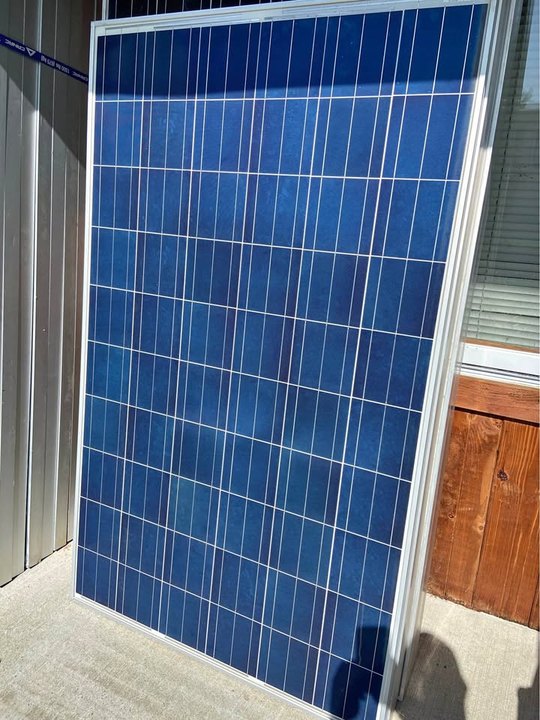
255 W polycrystalline panels, used — sold out
Canadian Solar CS6P-255P, made in Ontario. 39 inches by 65: the easiest of the 3 to handle and haul. The blue cells give away the polycrystalline — slightly less efficient per square foot than monocrystalline, but at this price it is space that costs you, not watts. The numbers for your controller: open-circuit voltage 37.4 V, maximum-power voltage 30.2 V, current 8.43 A. Count on 43.6 V per panel at −30 °C: 3 in series clear a 150 V controller, 4 do not. All sold. If this is the size you were after, do not leave empty-handed: the 330 W right next to it works out to 30¢ a watt, slightly less per watt than the 255 W was, and there are still some. Write to me with the wattage you need and I will tell you what is on the ground.
View the 330 W panels on Marketplace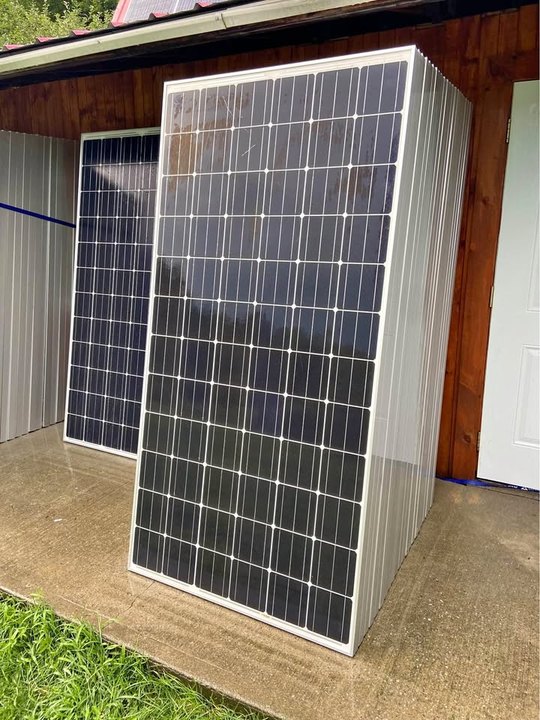
330 W monocrystalline panels, used — $100
SunEdison SE-F330BCC-36, made in Canada. Every one tested individually, and above 90 % of original capacity. 39 inches by 77, 22 kg each — bring a trailer or a pickup from 3 or 4 panels up. The numbers you need to pick your controller: open-circuit voltage 46.2 V, maximum-power voltage 37.7 V, current 8.77 A. Count on 53.8 V per panel at −30 °C instead: 2 in series clear a 150 V controller, 3 do not. $100 each, $90 from 10 up.
View the Marketplace listing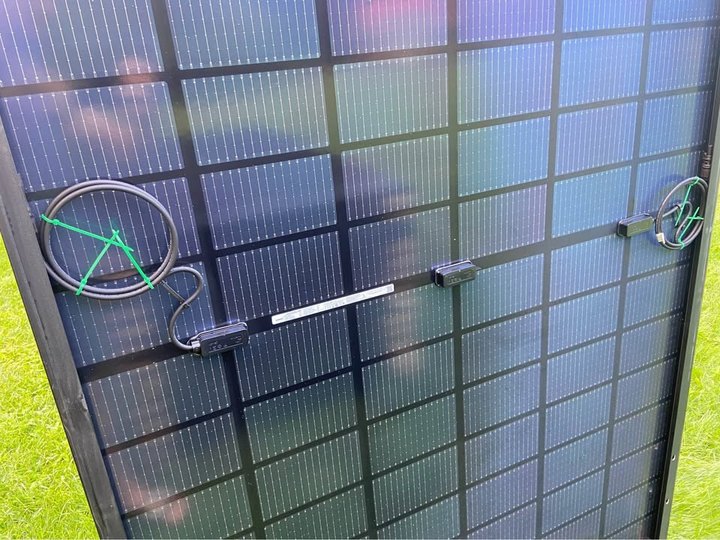
500 W bifacial panels, new — $200
LONGi 500 W bifacial, new, 44 inches by 78. At $200 that is roughly 40 cents a watt for new panels — and you need half as many for the same output: fewer mounts, fewer connectors, less time spent installing. Bifacial panels also catch the light coming back from behind, and in Quebec snow on the ground is about the best reflective surface there is: that bonus lands in midwinter, exactly when production collapses. To collect it, raise them and keep the back clear — on a ground or pile mount, it is free yield. $200 each, $180 from 10 up.
View the Marketplace listingThe listings open on Facebook Marketplace, where you can message me directly. If a listing is up, I still have them.
First: 12, 24 or 48 volts?
This is the first decision, and it determines everything else — controller, batteries, inverter and wiring all have to speak the same voltage. The basic rule: the higher the voltage, the less current flows for the same power. Less current means thinner cables, fewer losses and less heat.
| Voltage | Target power | Who it's for | Worth knowing |
|---|---|---|---|
| 12 V | Up to about 1,500 W | RV, cabin, weekend cottage, backup for essential appliances | The cheapest components, and the easiest to find. In exchange, 1,500 W at 12 V means more than 125 A: heavy cable, properly tightened terminals and correctly sized fuses are no longer optional. |
| 24 V | About 1,500 to 5,000 W | Year-round cottage, full backup for a house | The best compromise for most people: half the current of 12 V, reasonable wiring, and still a wide choice of equipment. |
| 48 V | 5,000 W and up | Whole house, off-grid, extended self-sufficiency | The standard for modern hybrid inverters. The most efficient, but the equipment costs more and the installation demands care. |
3 principles not to forget: every battery in a bank must be identical (same model, same age); the controller must accept the open-circuit voltage of your panel string in cold weather, which is higher than in summer; and every section of the circuit needs its own protection.
Or: a portable power station, and nothing to build
Everything that follows assumes you want to build a system. You don’t have to. A battery generator — also called a portable power station — gives you power without crimping a single cable: less autonomy, but nothing to understand and nothing to install — and it still recharges from solar, used panels included. I compare them on a page of their own: Jackery, BLUETTI and EcoFlow, lined up by capacity tier.
Compare battery generators
12 V12-volt system
17 items
12-volt system
For an RV, a cabin or backup for your essential appliances. Simple to build, with parts that are easy to find — as long as you do not skimp on cable gauge.

12 V MPPT charge controller
It matches the panel voltage to the battery voltage and pulls up to 30 % more out of them than a PWM controller. Size it according to the total amperage of your panels.
The model linked here detects 12, 24, 36 or 48 V on its own and handles up to 100 A. That is more than a 12 V build needs, but it will follow you if you move up in voltage later.

12 V LiFePO4 battery — to start with
Lithium iron phosphate can be discharged almost completely and lasts thousands of cycles, unlike lead-acid batteries, which should never be taken below half.
The model linked here gives 100 Ah, or 1,280 Wh, with a 100 A BMS and Bluetooth charge monitoring — handy for checking where you stand without digging out the multimeter. More importantly, it cuts off charging on its own below 0 °C — the detail that matters in a Canadian winter, because a lithium battery charged while frozen is damaged for good. Group 24 case, the size of a car battery.
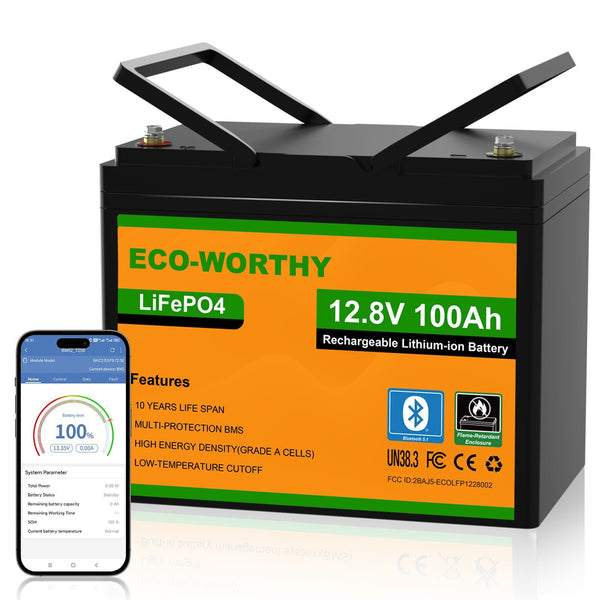
ECO-WORTHY 12 V 100 Ah — Bluetooth, sold in Canada
The same format as the previous one: 100 Ah at 12.8 V, or 1,280 Wh, with a 100 A BMS and Bluetooth monitoring through an app. Its difference is the seller: ECO-WORTHY Canada, with a Canadian warehouse, a 3-year warranty and over 50 reviews. You can wire up to 4 in series, so you can move to 24 or 48 V later with the same batteries. One thing to watch: its charge cut-off trips at −7 °C, while the maker itself sets 0 °C as the minimum charging temperature. In between, nothing protects it: if it has to charge in winter, keep it somewhere heated. 10.5 kg.
View at ECO-WORTHY
12 V LiFePO4 battery — high capacity
The same technology with 3 times the reserve: 300 Ah, or 3,840 Wh, with a 200 A BMS and a rated life of over 6,000 cycles. This is the one to pick if you want to go several days without sun rather than a few hours. A single large battery usually costs less than 3 small ones for the same capacity, and it spares you the parallel connections that cause most of the trouble. Do plan for the space and the weight, though. This one cuts off charging on its own below 0 °C — the detail that matters in a Canadian winter, because a lithium battery charged while frozen is damaged for good.
$564.99 View on Amazon
12 V pure sine inverter — 1,500 W
A pure sine wave is necessary for electronics, motors and medical devices. Modified sine wave models cost less but damage certain equipment.
The model linked here delivers 1,500 W at 12 V — the ceiling for this category — with 4 outlets, USB and USB-C ports, and a remote so you can switch it on without walking down to the basement. One thing not to miss: 1,500 W at 12 V means about 139 A pulled from the battery, efficiency included. That calls for a BMS able to supply it — the high-capacity battery above (200 A BMS) handles it comfortably, while the entry model (100 A BMS) will trip into protection before reaching full power. With that one, aim for 1,000 W instead.

12 V pure sine inverter — 2,000 W
When 1,500 W is not enough — a sump pump, a freezer and the rest of the household at once — this one delivers 2,000 W continuous and takes 4,000 W of surge, which covers a motor’s startup draw. Over 90 % efficiency, 3 outlets, a USB port and a remote. Know what you are asking for: 2,000 W at 12 V is about 185 A, efficiency included. You are past what I recommend at this voltage — you need the 200 A BMS battery, very heavy cable, and the inverter mounted within inches of the terminals. At this power level, moving up to 24 V often costs less than the copper you would otherwise buy.
$395.99 View on Amazon
32 A DC disconnect — panel side
Cable of adequate gauge, MC4 connectors, fuse holders and a breaker between the panels, the controller and the battery. This is the part people skimp on, and it's the part that starts fires.
The model linked here is a 32 A / 500 V DC disconnect in a weatherproof IP65 enclosure, equally at home at 12, 24 or 48 V. It goes between the panels and the controller: it is what lets you shut the production down to work safely. Note that it does not replace battery-side protection, which must be sized far larger — that is where the highest currents flow.

MC4 crimping kit — tool and connectors
Making your own runs costs less than buying ready-made extensions, and you cut exactly what you need. This kit holds 10 male-female connector pairs, spare pins, the 2 wrenches for tightening the bodies, and the crimping tool with the right dies. Do not try it with an ordinary crimper: the die profile is different, and a sloppy crimp is the leading cause of heating in a solar install. Fits 13 to 10 AWG.
$34.28 View on Amazon
Panel mounting
A poorly secured panel ends up vibrating, chafing its own wiring and leaving with the first strong gust. Z brackets are the simplest answer for a flat or slightly pitched roof — an RV roof, a shed, an outbuilding. The set linked here is a Renogy 4-piece kit, which is what one single panel needs: budget one set per panel. Plan on roof sealant for every hole you drill, or you will solve one problem by creating another.
$16.13 View on Amazon
1/0 AWG battery cables
This is the cable that ties the battery to the inverter, and it is the link people almost always underestimate. The set linked here is 1/0 AWG — the gauge the 139 to 185 A of a 1,500 to 2,000 W inverter calls for — with one red and one black cable of 0.9 m, and 3/8 in ring lugs already crimped on all 4 ends. 2 things to check before ordering: the seller lists several gauges and lengths under the same item, so pick the right variant; and measure your terminal posts, because a 3/8 in lug will not fit a larger bolt. Note too that this is pure copper, not copper-clad aluminium: at the same gauge, CCA runs hotter and corrodes at the terminals. The price difference is real, but this is the wrong place to save money.
$60.99 View on Amazon
Y branch panel splitters
For wiring several panels in parallel into a single controller input. The set linked here is a pair of Y branch splitters — one male to 3 female and the reverse — in a sealed IP67 housing rated 1,000 V, compatible with 14 to 10 AWG PV cable. Do the math before ordering: in parallel, currents add up. The spec sheet rates the connector at 20 A even though the title claims 30 A — go with the lower figure. 3 100 W panels stay under the limit; 3 200 W panels go over it. And a caveat that depends on your voltage: parallel keeps voltage low and pushes current up, which suits 12 V well. At 24 V and especially 48 V you want the opposite — panels go in series to raise voltage and cut current. These splitters then serve to combine whole strings, not individual panels.
$17.88 View on Amazon
Main battery disconnect
The main cut-off: a lever that isolates the battery completely from the rest of the system. It is what lets you work safely, leave the installation alone for weeks, or kill everything in one motion if something starts heating up. The model linked here is rated 275 A continuous, 455 A for 5 minutes and 1,250 A cranking — above the roughly 231 A of the largest inverter on this page, the 10,000 W at 48 V. It takes 12 V through 48 V, and its 3/8 in studs accept the lugs on the cables above directly. Check the variant when ordering: the seller groups several amperages under one listing, and 275 A is the one you want. One confusion to avoid: a disconnect is not a fuse. This one cuts when you decide; it will not cut on its own during an overcurrent. Both have a role — plan on a fuse or DC breaker sized for your system as well.
$25.98 View on Amazon
Battery breaker — 12 V
The automatic protection on the battery side — the one that acts without you. Unlike the disconnect, it trips on its own on a short circuit or overload, before the cable heats up, and resets by hand. The right rating is calculated: inverter power ÷ voltage ÷ 0.9 for its efficiency, then at least 125% of that current.
• 1,500 W inverter → about 139 A, take the 200 A (link below).
• 2,000 W inverter → about 185 A, take the 250 A.
The cable must handle the breaker rating: 1/0 AWG covers both. This model is built for 12 and 24 V. For a large lithium bank, the Class T fuse in the 48 V section is safer still: it cleanly interrupts the huge current a lithium battery pushes into a short circuit.

MC4 solar cable — 10 AWG, 6 lengths
The plain cable every install needs: MC4 connectors at both ends, nothing to crimp. Tinned copper, PV-rated, UV and cold resistant. 6 lengths in the menu — 10, 20, 30, 40, 50 or 100 feet — and each kit holds 2 cables, one red and one black. 10 AWG carries 2 panel strings without heating up. Measure the real run, following walls and corners rather than straight lines: it is always longer than it looks.
$61.20−5 %$58.28 View on Amazon
Renogy solar cable — short runs
When the controller sits a few feet from the panels, there is no point paying for heavy cable. 3 choices in the menu: 5 ft or 20 ft in 12 AWG, or 10 ft in 10 AWG. Solar connectors already crimped at both ends. Where 12 AWG stops: past roughly 6 metres, or with 2 strings in parallel, go back to the 10 AWG above — the loss in the wire eats what the MPPT gains. A known brand, 742 reviews.
$28.96 View on Amazon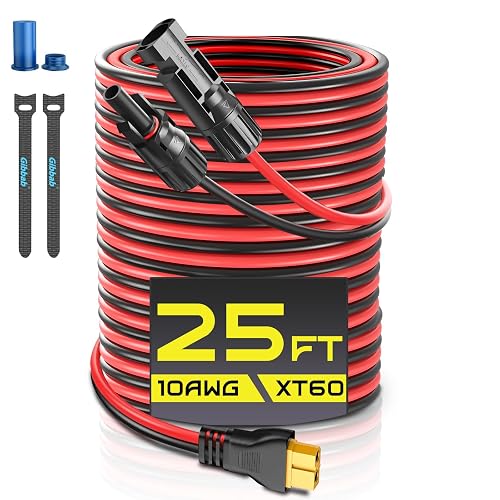
Solar-to-XT60 extension — 10 AWG, 7.6 m
The extension that connects your panels to a portable power station. Standard solar connectors on one end, an XT60 plug on the other — the input found on most stations and battery packs. Gauge matters more than length: in 10 AWG these 7.6 m cost you a negligible loss, where cheap 14 AWG would cost several percent over the same distance. And the length serves a precise purpose: the panel stays in the sun while the station stays in the shade and dry. Its limitation, and it is a real one: this is a cable for a portable station, not for a series string running to a fixed MPPT controller. As soon as the open-circuit voltage climbs, or you go past one or 2 panels, you go back to solar connectors straight into the controller.
$54.99 View on Amazon
Solar cable to Jackery (DC8020) — 12 AWG, 1.8 m
The cable that connects your panels to a Jackery station. Standard solar connectors on one end, an 8 mm plug on the other, with the DC8020 adapter included. Use the adapter: the bare plug is a DC7909, whose centre pin does not reach a Jackery's contact. That is the complaint that keeps coming up in the reviews, and that is where it comes from. In 12 AWG it easily carries the current of a 330 W panel, as well as a Jackery input, which tops out at 12 A. To go further than 1.8 m, make the run with 10 AWG solar wire and keep this cable for the last stretch, next to the station. On the largest Jackery units (3000 and up), check the adapter's fit when it arrives.
$33.79 View on Amazon
24 V24-volt system
16 items
24-volt system
The compromise I recommend most often: half the current of 12 V, with equipment that's still affordable.
24 V MPPT charge controller
Most models detect 12 or 24 V automatically. What matters most is the maximum input voltage: in deep cold, your panels produce more than their rated value.
The model linked here takes 150 V at the input and 100 A at the output — about 2,400 W at 24 V.

24 V LiFePO4 battery — 100 Ah
A single-block 24 V battery saves you from stacking 2 12 V units in series — fewer connections, less imbalance to watch. The model linked here gives 100 Ah, or 2,560 Wh, with protection against charging below 0 °C and a claimed life of up to 15,000 cycles. Do the math before ordering — this is the critical point of this section. Its BMS is capped at 100 A, which works out to roughly 2,150 W of inverter output at 24 V. Both inverters above ask for more: the 3,000 W draws about 139 A, the 4,000 W about 185 A. So one battery is not enough for either at full load. You need 2 in parallel — which doubles the available current and, along the way, the runtime. You would want that for a house anyway: 2,560 Wh goes quickly with a fridge and a pump running. Remember the rule stated at the top of this page: batteries in the same bank must be identical, same model and same age. Buy them together.
$429.89 View on Amazon
24 V hybrid inverter — 4,000 W · the one I use
This is the model I use myself, to power my office building. I am not recommending it on paper: I live with it every day. It delivers 4,000 W continuous, with a 140 A MPPT controller already built in and a 6.25 in touchscreen that shows in real time what is coming in, what is going out and where the battery stands — the kind of detail people underrate when buying and use every week. At 4,000 W you can carry a whole house on backup: the pump, the fridge, the freezer, the lighting and supplementary heat all at once. Size the protection accordingly: 4,000 W at 24 V is about 185 A, efficiency included. Take 250 A of protection and keep the 1/0 AWG cables short. It is also the one model on this page that makes a separate controller genuinely redundant — its 140 A of solar input exceeds what most residential arrays will ever produce.
$469.99 View on Amazon The same on AliExpress
Y&H 3,600 W — 24 V, 120 V output
The same kind of unit as the one I use, a little less powerful and a good deal cheaper. 3,600 W at 24 V, a built-in 120 A MPPT controller, 2 AC outlets, and up to 4,200 W of panels accepted at the input — room to grow later. Always check the output voltage before ordering: many inverters sold online put out 220 V, a European voltage that is of no use here. This one is 120 V.
$461.99 View on Amazon
SunGoldPower 3,000 W — 24 V, with AC charger
Dearer than the previous one for fewer watts, and still often the better buy. The difference is the 40 A AC charger: it refills your battery bank from a generator or the grid, not just from the sun. That is exactly what saves you on day 4 of an outage, when the sky has been grey for 3 days and the bank is sinking. 120 V output, 80 A MPPT.
$684.81 View on Amazon32 A DC disconnect — panel side
24 V allows thinner cable than 12 V for the same power — but the protection stays the same: a fuse or breaker on every section.
The model linked here is a 32 A / 500 V DC disconnect in a weatherproof IP65 enclosure, equally at home at 12, 24 or 48 V. It goes between the panels and the controller: it is what lets you shut the production down to work safely. Note that it does not replace battery-side protection, which must be sized far larger — that is where the highest currents flow.
MC4 crimping kit — tool and connectors
Making your own runs costs less than buying ready-made extensions, and you cut exactly what you need. This kit holds 10 male-female connector pairs, spare pins, the 2 wrenches for tightening the bodies, and the crimping tool with the right dies. Do not try it with an ordinary crimper: the die profile is different, and a sloppy crimp is the leading cause of heating in a solar install. Fits 13 to 10 AWG.
$34.28 View on AmazonPanel mounting
A poorly secured panel ends up vibrating, chafing its own wiring and leaving with the first strong gust. Z brackets are the simplest answer for a flat or slightly pitched roof — an RV roof, a shed, an outbuilding. The set linked here is a Renogy 4-piece kit, which is what one single panel needs: budget one set per panel. Plan on roof sealant for every hole you drill, or you will solve one problem by creating another.
$16.13 View on Amazon1/0 AWG battery cables
This is the cable that ties the battery to the inverter, and it is the link people almost always underestimate. The set linked here is 1/0 AWG — the gauge the 139 to 185 A of a 1,500 to 2,000 W inverter calls for — with one red and one black cable of 0.9 m, and 3/8 in ring lugs already crimped on all 4 ends. 2 things to check before ordering: the seller lists several gauges and lengths under the same item, so pick the right variant; and measure your terminal posts, because a 3/8 in lug will not fit a larger bolt. Note too that this is pure copper, not copper-clad aluminium: at the same gauge, CCA runs hotter and corrodes at the terminals. The price difference is real, but this is the wrong place to save money.
$60.99 View on AmazonY branch panel splitters
For wiring several panels in parallel into a single controller input. The set linked here is a pair of Y branch splitters — one male to 3 female and the reverse — in a sealed IP67 housing rated 1,000 V, compatible with 14 to 10 AWG PV cable. Do the math before ordering: in parallel, currents add up. The spec sheet rates the connector at 20 A even though the title claims 30 A — go with the lower figure. 3 100 W panels stay under the limit; 3 200 W panels go over it. And a caveat that depends on your voltage: parallel keeps voltage low and pushes current up, which suits 12 V well. At 24 V and especially 48 V you want the opposite — panels go in series to raise voltage and cut current. These splitters then serve to combine whole strings, not individual panels.
$17.88 View on AmazonMain battery disconnect
The main cut-off: a lever that isolates the battery completely from the rest of the system. It is what lets you work safely, leave the installation alone for weeks, or kill everything in one motion if something starts heating up. The model linked here is rated 275 A continuous, 455 A for 5 minutes and 1,250 A cranking — above the roughly 231 A of the largest inverter on this page, the 10,000 W at 48 V. It takes 12 V through 48 V, and its 3/8 in studs accept the lugs on the cables above directly. Check the variant when ordering: the seller groups several amperages under one listing, and 275 A is the one you want. One confusion to avoid: a disconnect is not a fuse. This one cuts when you decide; it will not cut on its own during an overcurrent. Both have a role — plan on a fuse or DC breaker sized for your system as well.
$25.98 View on Amazon
Battery breaker — 24 V
The automatic protection on the battery side — the one that acts without you. It trips on its own on a short circuit or overload, before the cable heats up, and resets by hand. The right rating is calculated: inverter power ÷ voltage ÷ 0.9 for its efficiency, then at least 125% of that current.
• 3,000 W inverters → about 139 A, take the 200 A.
• 3,600 and 4,000 W inverters → 167 to 185 A, take the 250 A (link below).
1/0 AWG cable covers both ratings. This model is built for 12 and 24 V only: at 48 V, see the Class T fuse.
MC4 solar cable — 10 AWG, 6 lengths
The plain cable every install needs: MC4 connectors at both ends, nothing to crimp. Tinned copper, PV-rated, UV and cold resistant. 6 lengths in the menu — 10, 20, 30, 40, 50 or 100 feet — and each kit holds 2 cables, one red and one black. 10 AWG carries 2 panel strings without heating up. Measure the real run, following walls and corners rather than straight lines: it is always longer than it looks.
$61.20−5 %$58.28 View on AmazonRenogy solar cable — short runs
When the controller sits a few feet from the panels, there is no point paying for heavy cable. 3 choices in the menu: 5 ft or 20 ft in 12 AWG, or 10 ft in 10 AWG. Solar connectors already crimped at both ends. Where 12 AWG stops: past roughly 6 metres, or with 2 strings in parallel, go back to the 10 AWG above — the loss in the wire eats what the MPPT gains. A known brand, 742 reviews.
$28.96 View on AmazonSolar-to-XT60 extension — 10 AWG, 7.6 m
The extension that connects your panels to a portable power station. Standard solar connectors on one end, an XT60 plug on the other — the input found on most stations and battery packs. Gauge matters more than length: in 10 AWG these 7.6 m cost you a negligible loss, where cheap 14 AWG would cost several percent over the same distance. And the length serves a precise purpose: the panel stays in the sun while the station stays in the shade and dry. Its limitation, and it is a real one: this is a cable for a portable station, not for a series string running to a fixed MPPT controller. As soon as the open-circuit voltage climbs, or you go past one or 2 panels, you go back to solar connectors straight into the controller.
$54.99 View on AmazonSolar cable to Jackery (DC8020) — 12 AWG, 1.8 m
The cable that connects your panels to a Jackery station. Standard solar connectors on one end, an 8 mm plug on the other, with the DC8020 adapter included. Use the adapter: the bare plug is a DC7909, whose centre pin does not reach a Jackery's contact. That is the complaint that keeps coming up in the reviews, and that is where it comes from. In 12 AWG it easily carries the current of a 330 W panel, as well as a Jackery input, which tops out at 12 A. To go further than 1.8 m, make the run with 10 AWG solar wire and keep this cable for the last stretch, next to the station. On the largest Jackery units (3000 and up), check the adapter's fit when it arrives.
$33.79 View on Amazon
48 V48-volt system
24 items
48-volt system
To power a whole house or aim for real off-grid self-sufficiency. The most efficient, and the one that demands the most care.

48 V hybrid inverter — 6,000 W, 240 V output
The brain of the system: it manages the panels, the batteries and the distribution in a single box. The model linked here delivers 6,000 W continuous with a dual MPPT built in — 2 independent solar inputs, so you can use 2 roof faces with different orientations without one dragging the other down. Battery charging up to 200 A, breaker included, and up to 16 units in parallel if your needs grow. Its real differentiator: 240 V split-phase output. Almost every affordable inverter puts out 120 V only, which rules out a deep well pump, a dryer, a range and a heat pump. This one feeds the whole electrical panel. That is the difference between “keeping the fridge alive” and “the house runs normally”. And here is the case for 48 V in one number: 6,000 W at this voltage draws only about 139 A — exactly the same current as a 1,500 W system at 12 V. 4 times the power, the same cabling, the same 200 A of protection. That is why a whole house is done at 48 V.
$2,022.18 View on Amazon
POWLAND 48 V — split phase, 100 A MPPT
The way into 48 V, and the cheapest all-in-one on this page. 120 V split-phase output, a 100 A MPPT controller, works with lead-acid and lithium alike. Over a 100 reviews, which is rare in a category where most models have 3. What it lacks: UL certification. For a permanent install wired into a house panel, that is the question to settle before buying: your insurer will not read the reviews, they will look for the stamp. For a panel tie-in, take the UL1741-listed ECO-WORTHY 5,000 W further down this section instead.
$502.03 View on Amazon
SunGoldPower 5,000 W — 48 V, with AC charger
Same maker as the 3,000 W at 24 V, built for 48. 100 A MPPT and a 40 A AC charger: sun and generator both. 5 000 watts is the threshold where you stop choosing what to power — the well pump, the furnace blower and the fridge can all run at once without thinking about it.
$1,156.68 View on Amazon
POWLAND 10,000 W — 48 V, 120 and 240 V
The biggest on this page. 10 000 watts, 120 and 240 V output, a 200 A MPPT controller. The 240 V is no detail: it is what runs a deep well pump, a water heater or a dryer — the appliances no 120 V inverter will ever start. At this power you stop improvising: the battery-side wiring becomes real work, and tying into the panel calls for a licensed contractor.
$1,632.78 View on Amazon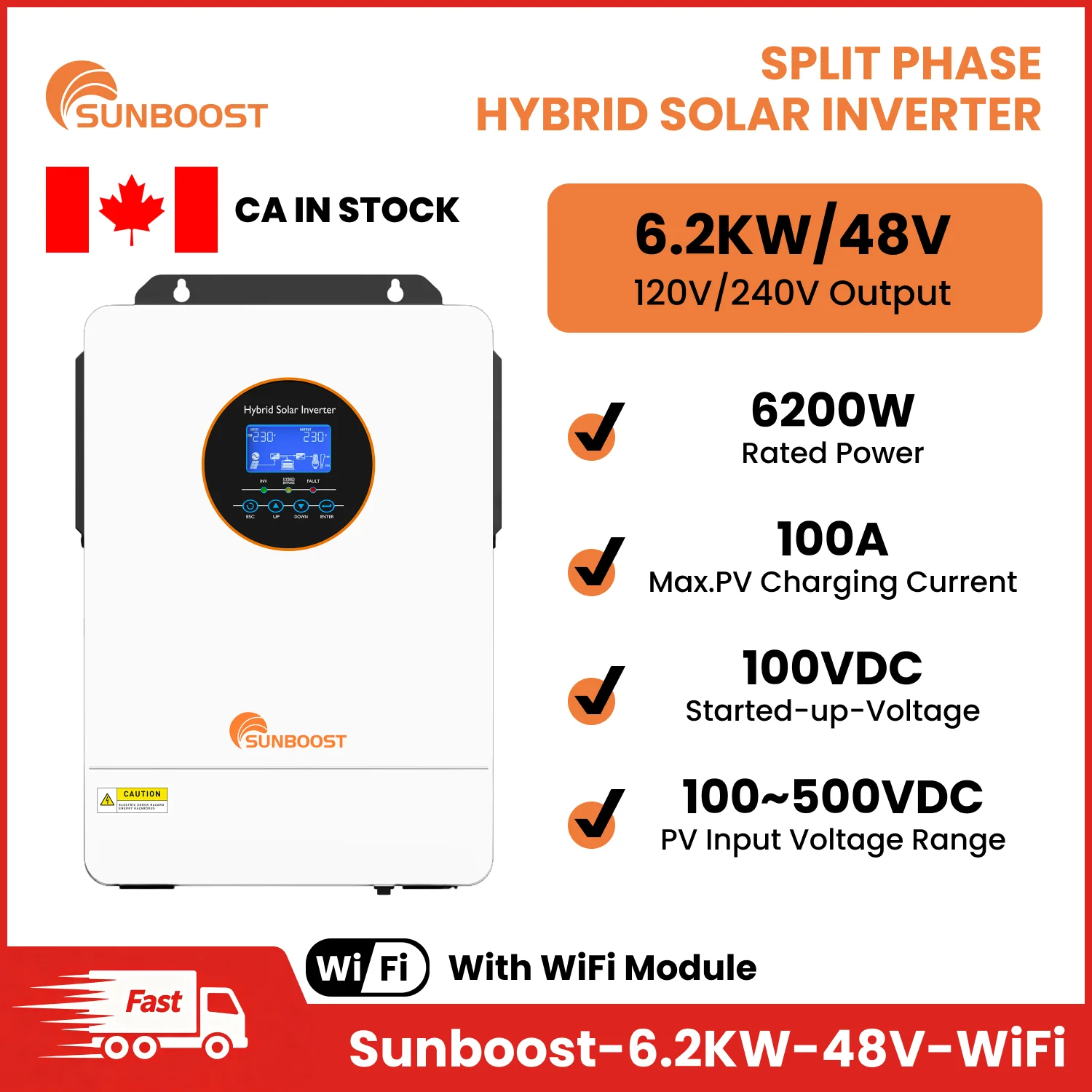
Sunboost 6.2 kW hybrid inverter — 48 V, 120 and 240 V
The step that was missing between 5,000 W and 10,000 W. Split-phase 120 and 240 V output: it feeds the whole house panel, well pump included, not just a few outlets. What sets it apart is the Canadian warehouse — delivered in a week, no customs and no brokerage fees, unlike most inverters at this price. On the panel side: it works between 120 and 450 V, so you need at least 4 330 W panels in series for it to start, and 8 at most in deep cold. The maker does not publish its maximum open-circuit voltage: I use 450 V to be safe, and I suggest you check the label on arrival before wiring a longer string. Connection to the house panel is done by a master electrician, and that is not negotiable.
View on AliExpress
PowMr 10 kW hybrid inverter — 48 V, 120 and 240 V
The largest one I list, for a house you want to keep running in full. 2 separate solar inputs of 5,500 W each, with their own 100 A MPPT controller: you can aim 2 panel arrays differently, one south-east and the other south-west, and harvest from morning to evening without one penalising the other. Up to 500 V open-circuit, so 9 330 W panels in series per input. But it does not start below 125 V: under 5 panels in series it stays silent. This is not a cottage inverter, it is a house inverter. Shipped from China, allow one to 2 weeks. Connection by a master electrician.
View on AliExpress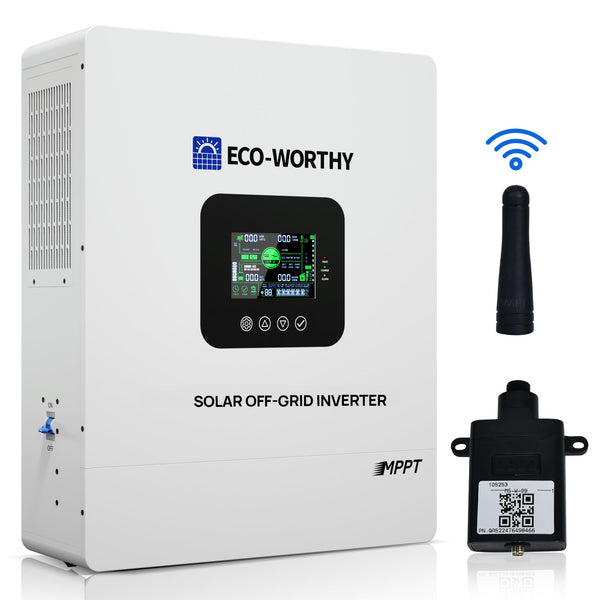
ECO-WORTHY 5,000 W — 48 V, UL1741 listed
The certified model this page was missing. Listed to UL1741, which is what the insurer and the inspector will look for, and sold directly by the maker. 5,000 W continuous, an 80 A MPPT controller, up to 5,500 W of panels between 120 and 500 V — 4 to 9 330 W panels in series. It even runs without a battery, straight off the panels, and up to 6 units can be wired in parallel. What you need to know: on its own, it puts out 120 V. The 240 V of a deep-well pump or a dryer takes 2 units in parallel, or the 10 kW a little further on. On the battery side, reckon on about 116 A at full load: 2 Cubix100s, or a single PowerMEGA314. Panel tie-in by a master electrician.
View at ECO-WORTHY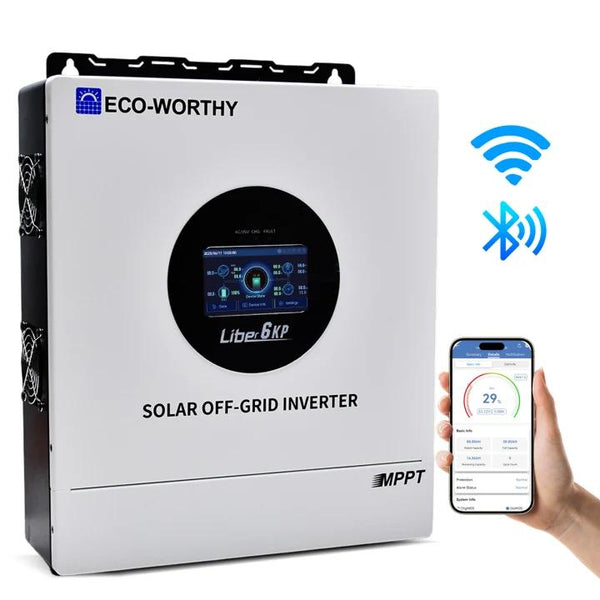
ECO-WORTHY 6 kW — 48 V, 120 and 240 V
The smallest of the ECO-WORTHY inverters on this page to put out 240 V from a single unit: 120 and 240 V split phase, 6,000 W continuous, enough to start a 4.8 HP motor such as a well pump’s. A 120 A MPPT controller, up to 9,000 W of panels, and dialogue with the Cubix100 over the Pylon protocol. On the panel side: a single input, which tracks the power point between 125 and 425 V and accepts 500 V open circuit — 5 to 9 330 W panels in series —, but 27 A at most: one string of bifacial JA Solar panels (17.30 A) fits, 2 in parallel do not. The detail that surprises: its AC charging input needs 240 V, from 180 to 280 V. A 120 V generator will not charge it. The maker gives it no UL listing: for a tie-in declared to your insurer, look at the 5,000 W or the 10 kW. On the battery side, about 139 A at full load: 2 Cubix100s or one PowerMEGA314. Panel tie-in by a master electrician.
View at ECO-WORTHY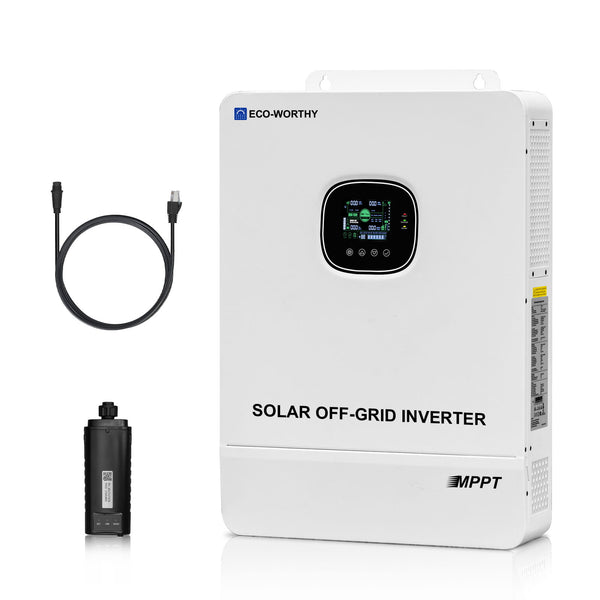
ECO-WORTHY 10 kW — 48 V, 120 and 240 V, UL1741 listed
To run the whole house, with the stamp. Listed to UL1741, with 120 and 240 V split-phase output from a single unit: deep-well pump, dryer, the whole electrical panel. A 200 A MPPT controller, up to 11,000 W of panels, Wi-Fi included, and closed-loop dialogue with the Cubix100 over the Pylon protocol. On the panel side: it tracks the power point between 125 and 425 V and accepts 500 V open circuit, so 5 to 9 330 W panels in series. Its AC charging runs on 120 V, and up to 6 units can be wired in parallel. On the battery side, do not underestimate it: at full power it draws over 200 A — 3 Cubix100s or 2 PowerMEGA314s. A 2-year warranty, shorter than the batteries’. Panel tie-in by a master electrician.
View at ECO-WORTHY
48 V battery — standard case, 200 A BMS
100 Ah at 48 V, or 5,120 Wh, in an ordinary case rather than a rack format. No rails to mount, no cabinet to plan for: set it down and wire it up. Its decisive advantage: a 200 A BMS, twice what rack modules of this capacity give. One unit therefore feeds either inverter in this section at full load — about 116 A for the 5,000 W, 139 A for the 6,000 W. A single battery does it, where a module with a 100 A BMS would force you to fit 2. Add protection against charging in the cold, Bluetooth monitoring through an app, and a claimed life of up to 15,000 cycles over 10 years. Reckon on 37 kg: heavy, but one person can move it. The trade-off to weigh: it has neither the UL9540 and UL1973 listings nor CAN/RS485 dialogue with the inverter. For a permanent installation declared to your insurer, a listed module is what an inspector will want to see, like the Cubix100 right next to it. For a cottage, a garage, or a build you want simple and expandable, this one does the job with a single unit.
$1,319.99−5 %$1,253.99 View on Amazon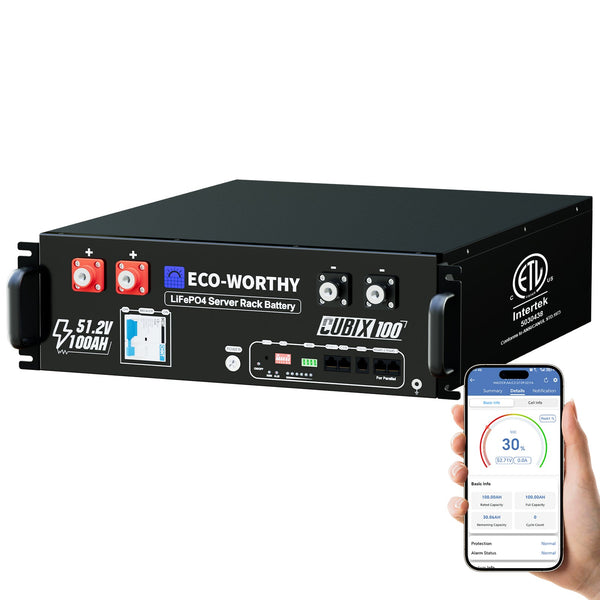
ECO-WORTHY Cubix100 — 48 V rack battery, UL listed
The answer to the question the battery next to it leaves open. Listed to UL9540 and UL1973 and on the CEC list: the stamp an inspector or an insurer will look for on a permanent installation. 100 Ah at 51.2 V, or 5,120 Wh, in a 3U rack format, with CAN and RS485 dialogue with the inverter: the inverter reads the battery’s real state instead of guessing it from the voltage. Grade A REPT cells, over 6,000 cycles at 80 % depth of discharge, 10-year warranty, Bluetooth and Wi-Fi monitoring, charging cut off below 0 °C, and up to 32 modules in parallel. The trade-off, this time, runs the other way: its BMS is 100 A. For a 5,000 to 6,000 W inverter at full load, 116 to 139 A, you need 2 — which gives 10.2 kWh, the right base for a house system. Reckon on 47 kg per module. Before you buy, check that your inverter is on the maker’s compatibility list (Victron, Deye, Growatt, LuxPower, Sol-Ark, EG4, SRNE…): if not, the battery still works, just without the dialogue. Sold by ECO-WORTHY Canada and shipped from a Canadian warehouse.
View at ECO-WORTHY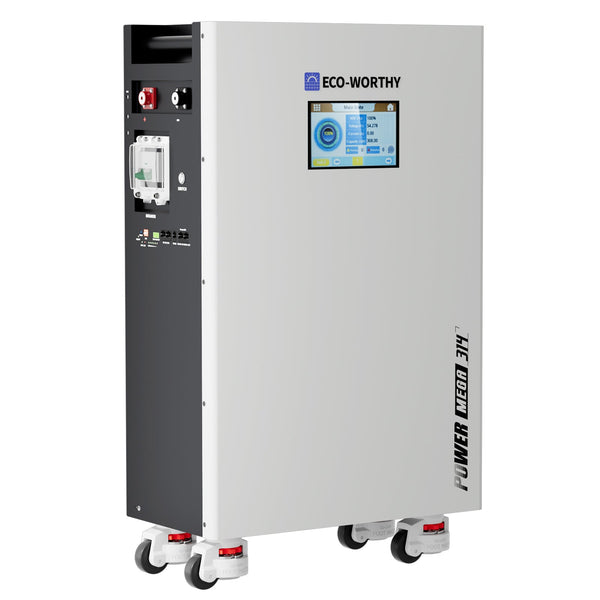
ECO-WORTHY PowerMEGA314 — 16 kWh at 48 V, on wheels
A whole house’s reserve in a single cabinet. 314 Ah at 51.2 V, or 16 kWh — a little more than 3 Cubix100s —, with a 200 A BMS: one unit is enough for an inverter of about 8,000 W at full load. Active cell balancing, over 9,000 rated cycles, a 7-inch touchscreen, Bluetooth and Wi-Fi monitoring, CAN and RS485 dialogue with the inverter, 2 125 A breakers and a built-in aerosol fire-suppression module. 10-year warranty, up to 15 units in parallel. 3 things to know before you order. It weighs 127 kg and arrives on a pallet by truck: check that the carrier delivers to your address and plan for help unloading it; the wheels do the rest. Like any lithium battery, it only charges above 0 °C: it belongs in a heated room. And the maker does not give it the Cubix100’s UL9540 and UL1973 listings: for an installation declared to your insurer, the Cubix100 is the one you want. Sold by ECO-WORTHY Canada.
View at ECO-WORTHYHigh-voltage MPPT controller
If your inverter has no built-in controller, you need one that can take a long string of panels in series — that's what allows thin cable over long distances.
The model linked here takes 150 V at the input and 100 A — close to 4,800 W at 48 V.
Disconnects and protection
At 48 V, an electrical arc does not extinguish itself the way it does at low voltage. DC-rated disconnects, fuse holders and surge protectors are not optional.
The model linked here is a 32 A / 500 V DC disconnect in a weatherproof IP65 enclosure, equally at home at 12, 24 or 48 V. It goes between the panels and the controller: it is what lets you shut the production down to work safely. Note that it does not replace battery-side protection, which must be sized far larger — that is where the highest currents flow.
MC4 crimping kit — tool and connectors
Making your own runs costs less than buying ready-made extensions, and you cut exactly what you need. This kit holds 10 male-female connector pairs, spare pins, the 2 wrenches for tightening the bodies, and the crimping tool with the right dies. Do not try it with an ordinary crimper: the die profile is different, and a sloppy crimp is the leading cause of heating in a solar install. Fits 13 to 10 AWG.
$34.28 View on AmazonPanel mounting
A poorly secured panel ends up vibrating, chafing its own wiring and leaving with the first strong gust. Z brackets are the simplest answer for a flat or slightly pitched roof — an RV roof, a shed, an outbuilding. The set linked here is a Renogy 4-piece kit, which is what one single panel needs: budget one set per panel. Plan on roof sealant for every hole you drill, or you will solve one problem by creating another.
$16.13 View on Amazon1/0 AWG battery cables
This is the cable that ties the battery to the inverter, and it is the link people almost always underestimate. The set linked here is 1/0 AWG — the gauge the 139 to 185 A of a 1,500 to 2,000 W inverter calls for — with one red and one black cable of 0.9 m, and 3/8 in ring lugs already crimped on all 4 ends. 2 things to check before ordering: the seller lists several gauges and lengths under the same item, so pick the right variant; and measure your terminal posts, because a 3/8 in lug will not fit a larger bolt. Note too that this is pure copper, not copper-clad aluminium: at the same gauge, CCA runs hotter and corrodes at the terminals. The price difference is real, but this is the wrong place to save money.
$60.99 View on AmazonY branch panel splitters
For wiring several panels in parallel into a single controller input. The set linked here is a pair of Y branch splitters — one male to 3 female and the reverse — in a sealed IP67 housing rated 1,000 V, compatible with 14 to 10 AWG PV cable. Do the math before ordering: in parallel, currents add up. The spec sheet rates the connector at 20 A even though the title claims 30 A — go with the lower figure. 3 100 W panels stay under the limit; 3 200 W panels go over it. And a caveat that depends on your voltage: parallel keeps voltage low and pushes current up, which suits 12 V well. At 24 V and especially 48 V you want the opposite — panels go in series to raise voltage and cut current. These splitters then serve to combine whole strings, not individual panels.
$17.88 View on AmazonMain battery disconnect
The main cut-off: a lever that isolates the battery completely from the rest of the system. It is what lets you work safely, leave the installation alone for weeks, or kill everything in one motion if something starts heating up. The model linked here is rated 275 A continuous, 455 A for 5 minutes and 1,250 A cranking — above the roughly 231 A of the largest inverter on this page, the 10,000 W at 48 V. It takes 12 V through 48 V, and its 3/8 in studs accept the lugs on the cables above directly. Check the variant when ordering: the seller groups several amperages under one listing, and 275 A is the one you want. One confusion to avoid: a disconnect is not a fuse. This one cuts when you decide; it will not cut on its own during an overcurrent. Both have a role — plan on a fuse or DC breaker sized for your system as well.
$25.98 View on Amazon
Class T fuse — 48 V
At 48 V, battery protection is done with a Class T fuse, not an automotive breaker. 2 reasons: a 48 V battery charges to around 58 V, beyond what most resettable breakers guarantee; and a lithium battery pushes a huge current into a short circuit that only a high-interrupt fuse stops cleanly. This one handles 150 V DC and interrupts up to 10,000 A, according to the maker, holder included. The right rating is calculated: inverter power ÷ voltage ÷ 0.9 for its efficiency, then at least 125% of that current.
• 5,000 W inverters → about 116 A, take the 150 A.
• 6,000 W inverter → about 139 A, take the 200 A (link below).
• POWLAND 10,000 W → about 231 A, take the 300 A.
The cable must handle the fuse rating: 1/0 AWG up to 250 A, 2/0 AWG at minimum for the 300 A. Still a lightly reviewed product: I point that out in fairness.
MC4 solar cable — 10 AWG, 6 lengths
The plain cable every install needs: MC4 connectors at both ends, nothing to crimp. Tinned copper, PV-rated, UV and cold resistant. 6 lengths in the menu — 10, 20, 30, 40, 50 or 100 feet — and each kit holds 2 cables, one red and one black. 10 AWG carries 2 panel strings without heating up. Measure the real run, following walls and corners rather than straight lines: it is always longer than it looks.
$61.20−5 %$58.28 View on AmazonRenogy solar cable — short runs
When the controller sits a few feet from the panels, there is no point paying for heavy cable. 3 choices in the menu: 5 ft or 20 ft in 12 AWG, or 10 ft in 10 AWG. Solar connectors already crimped at both ends. Where 12 AWG stops: past roughly 6 metres, or with 2 strings in parallel, go back to the 10 AWG above — the loss in the wire eats what the MPPT gains. A known brand, 742 reviews.
$28.96 View on AmazonSolar-to-XT60 extension — 10 AWG, 7.6 m
The extension that connects your panels to a portable power station. Standard solar connectors on one end, an XT60 plug on the other — the input found on most stations and battery packs. Gauge matters more than length: in 10 AWG these 7.6 m cost you a negligible loss, where cheap 14 AWG would cost several percent over the same distance. And the length serves a precise purpose: the panel stays in the sun while the station stays in the shade and dry. Its limitation, and it is a real one: this is a cable for a portable station, not for a series string running to a fixed MPPT controller. As soon as the open-circuit voltage climbs, or you go past one or 2 panels, you go back to solar connectors straight into the controller.
$54.99 View on AmazonSolar cable to Jackery (DC8020) — 12 AWG, 1.8 m
The cable that connects your panels to a Jackery station. Standard solar connectors on one end, an 8 mm plug on the other, with the DC8020 adapter included. Use the adapter: the bare plug is a DC7909, whose centre pin does not reach a Jackery's contact. That is the complaint that keeps coming up in the reviews, and that is where it comes from. In 12 AWG it easily carries the current of a 330 W panel, as well as a Jackery input, which tops out at 12 A. To go further than 1.8 m, make the run with 10 AWG solar wire and keep this cable for the last stretch, next to the station. On the largest Jackery units (3000 and up), check the adapter's fit when it arrives.
$33.79 View on AmazonFrequently asked questions
Which voltage should I choose for a solar system: 12, 24 or 48 volts?
The rule follows the power you are aiming for. 12 V suits systems up to about 1,500 W: an RV, a cabin, or backup for essential appliances. 24 V covers 1,500 to 5,000 W, meaning a year-round cottage or full backup for a house. 48 V takes over from 5,000 W, for a whole house or off-grid self-sufficiency. The higher the voltage, the less current flows for the same power: thinner cable, lower losses and a cheaper installation.
What size circuit breaker do I need for a solar inverter?
First work out the current the inverter pulls from the battery at full load: power divided by voltage, then by 0.9 for its efficiency. Then pick a rating of at least 125% of that current. A 1,500 W inverter at 12 V draws about 139 A and needs at least 175 A of protection — in practice, the 200 A. The same 1,500 W at 24 V draws only about 69 A. A 2,000 W unit at 12 V reaches about 185 A and requires 250 A, while at 48 V it asks for only about 46 A.
Why do I need a pure sine wave inverter?
A pure sine wave faithfully reproduces grid power. It is necessary for electronics, motors and medical devices. Modified sine wave inverters cost less, but they make some motors run hot, interfere with audio equipment and damage sensitive gear over time.
Does a battery disconnect switch replace a fuse?
No. A disconnect cuts the circuit when you decide to: it is there so you can work safely or isolate the system. A fuse or breaker cuts on its own during an overcurrent, before the cable heats up. Both are necessary and serve distinct roles.
Should solar panels be wired in series or in parallel?
In parallel, voltage stays the same and currents add up, which suits a 12 V system. In series, voltage rises and current falls, which is what you want at 24 and especially 48 V because it allows thinner cable over long runs. Always check that the controller accepts your string's open-circuit voltage in deep cold, which is higher than in summer.
Why is a 100 Ah battery not enough for a 2,000 W inverter?
Because amp-hour capacity and maximum current are 2 different things. A 100 Ah battery with a BMS capped at 100 A will not pass more than that, while a 2,000 W inverter at 12 V calls for about 185 A. The BMS trips into protection before full power. You need either a battery whose BMS handles the current, or 2 batteries in parallel.
Can a lithium battery be charged in cold weather?
No, and this is critical in a Canadian winter. A LiFePO4 battery charged below 0 °C is permanently damaged. Choose a model with low-temperature protection, which cuts charging on its own below the threshold, or install the bank in a heated space.
Can a portable power station run a refrigerator?
It depends on its surge power, not its capacity. A fridge draws roughly 150 W running, but demands 3 to 6 times that when the compressor starts — often 900 W and more. A station whose surge caps at 600 W will not start it, even if its watt-hour capacity looks ample. Aim for a surge of at least 2,000 W.
Can a power station be recharged with used solar panels?
Yes. Most stations accept a solar input through an XT60 or MC4 connector, and a used panel in good condition works there exactly like a new one. All you need is an extension of the right gauge between the 2, and a check that the panel’s cold-weather open-circuit voltage stays below the station’s input limit.
Portable power station or generator for a winter outage?
Both, if the budget allows. A generator does the heavy lifting in short bursts but needs fuel and must never be run indoors — carbon monoxide kills every winter. A portable station is silent and safe inside, but its capacity is finite. Solar is what settles the underlying problem: it refills itself, with no jerry can and no road to drive.
Will your setup actually work?
You have the panels. Before you buy the rest, we go over the voltage, the currents, the cable gauge and the protections together — and you leave with the exact list of what you're still missing, quantities and models included.
Book my consultation — $249Still wondering where to start? The 30-minute assessment is free.