As an Amazon Associate, I earn from qualifying purchases.
This commission changes nothing about the price you pay, and it doesn't influence my recommendations: I only list gear I consider reliable and suited to Quebec conditions. Always check the specifications and the price on the product page before buying.
4 rules before you buy anything at all
Most of the evacuation bags I see on visits fail for the same reason: they're too heavy, too far away, or full of gear nobody has ever tried. Settle these 4 points first and the rest will follow.
One bag per person
Everyone carries their own, children included — a small bag with a water bottle, a coat and a stuffed animal is enough. A single family bag becomes impossible to carry the moment you have to walk.
10 to 15 % of your body weight
Someone weighing 80 kg aims for 8 to 12 kg, everything included. Above that, you'll leave the bag behind — which amounts to not having one.
72 hours, not 3 weeks
The bag covers the trip out and the first days away from home. Long-term self-sufficiency is prepared at home — that's a different exercise.
Near the door, not in the basement
The front hall closet or the trunk of the car. And a check twice a year, at the time changes: batteries, medication, clothing in the right size.
The container
We start with the bag, because its size decides everything else. Too small and you'll leave the essentials behind; too big and you'll fill it with useless gear until you can no longer carry it.
-

A 40 to 55 litre backpack
EssentialThe size that holds 3 days of self-sufficiency without turning into a move. Below 40 L you'll run out of room the moment warm clothing goes in; above 55 L the temptation to overfill becomes irresistible.
What to look for: a padded hip belt — it's what transfers the weight onto your hips, and what makes the difference after an hour of walking. Then: 600D fabric or heavier, doubled stitching at the straps, a rain cover included, and a panel opening rather than top-loading only.$47.99 View on Amazon -

Convertible carry-on, 60 L
For evacuating by vehicleIf you're evacuating by car rather than on foot, the priorities change: it's no longer about carrying comfort but about volume and quick access. This size opens flat like a suitcase, converts into a duffle, and fits as carry-on baggage if the evacuation takes you as far as an airport.
What to look for: a full panel opening — that's what saves you from emptying everything to reach the bottom. On the other hand, this kind of bag has no padded hip belt: it isn't the one you carry on foot for an hour.$95.00 View on Amazon -

Waterproof compression sacks
Comfort3 or 4 sacks in different colours, and the contents stop being a jumble: one for clothing, one for food, one for electronics. You find what you're looking for without emptying everything onto the ground, and nothing gets wet.
What to look for: a rolling closure (roll-top) rather than a plain zipper, and sizes of 5, 10 and 20 L. Sturdy freezer bags do the job the first year.$19.99 View on Amazon
Water
It's the most urgent need and the heaviest: a litre weighs a kilo. The answer isn't to carry 72 hours of water, but to carry a little and be able to produce more.
-

Stainless steel bottle, 1 litre
EssentialA single-wall stainless bottle fills, carries — and sits directly on coals to boil water. It's your purification method of last resort, the one that works when the filter is frozen or clogged.
What to look for: single-wall, definitely not vacuum-insulated (an insulated bottle bursts on a fire), a wide mouth so you can fill it in a stream, and an attached cap that won't get lost.$34.99 View on Amazon -
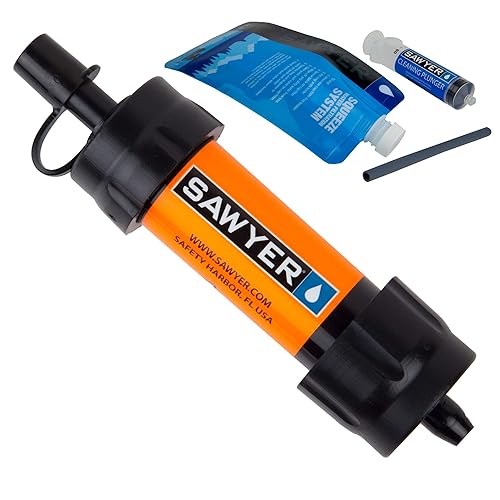
Sawyer Mini — screw-on filter
EssentialMy first choice for a bag, precisely because it screws onto a standard water bottle or a hydration bladder: you fill, you screw it on, you drink while walking. No battery, no chemicals, no waiting.
$54.99−20 %$44.09 View on Amazon -

LifeStraw — personal filter
AlternativeSimpler still: you drink straight from the source. It filters up to 4,000 litres and fits in a coat pocket. Get one per person — it's the cheapest item that solves the biggest problem.
$17.64 View on Amazon -

Aquatabs — purification tablets
EssentialThe filter's spare tire: one tablet per litre, 30 minutes of waiting, and the water is drinkable. It weighs a few grams, it doesn't freeze, and it almost never expires. No reason to go without.
$20.69 View on Amazon
Food
3 days without food won't kill anyone, but an empty stomach leads to bad decisions — and that's even truer with children. Aim for compact energy that can be eaten cold, with no preparation.
-

Rations and bars — 72 hours of energy
EssentialGranola bars, peanut butter in sachets, nuts, dried fruit, jerky. The criterion that comes first: it can be eaten as is, cold, with no dishes. Military-style compressed rations are a compact option, but taste them before you count on them.
What to look for: a best-before date at least 2 years out, tolerance to freezing (a chocolate bar turns to stone at −20 °C), and above all: food your family already eats. An emergency is not the moment to discover you don't like something.$18.23 View on Amazon -
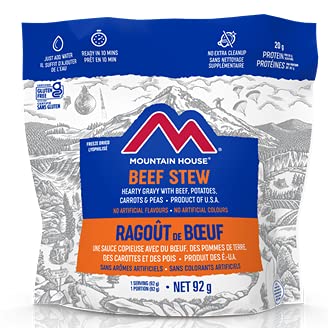
Freeze-dried meals
If you have the stoveThis is what completes the survival bars: a real hot meal, around 500 to 600 kcal, ready in about 10 minutes. You pour boiling water straight into the pouch, wait, and eat out of it — no dishes, and no extra container to carry.
What to look for: count on about 500 ml of water per pouch, and this is where you have to be clear-eyed: these meals are only useful if you have both the stove and the water. Save them for days 2 and 3, when morale counts for more than calories. The serious brands state a shelf life of 25 to 30 years.$23.95 View on Amazon -

Manual can opener
EssentialA few dollars, a few grams — and without it, a can stays a can. It's the most frequent oversight in the bags I inspect. A sturdy model, tied to the bag with a cord.
$26.99 View on Amazon -

Pocket stove and fuel
ComfortA hot coffee or a soup completely changes the mood of an evening outdoors, and it's what makes the freeze-dried meals usable. This model folds flat like a glasses case, weighs almost nothing, and burns solid fuel tablets just as well as twigs gathered on the spot — the dual-fuel tabletop stove from the shop, on the other hand, stays at home.
What to look for: carry spare fuel tablets and a storm lighter. Solid fuel is slow — count on about 10 minutes to bring 500 ml to a boil — but it doesn't freeze, doesn't leak and doesn't go flat at the bottom of a bag forgotten for 6 months. Strictly outdoor use: never under a tent and never in a closed garage.$8.29 View on Amazon -

Solid fuel tablets
Essential with the stoveThe folding stove is useless without them. A 15 g tablet burns for about 10 minutes, with no flickering flame and no black smoke — enough for one freeze-dried pouch or 2 cups of coffee. 20 tablets fit in a box the size of a deck of cards.
What to look for: they double as fire starters: they light even when damp and burn long enough to catch wet wood, which settles part of step 3 at the same time. Store them in a sealed bag — they give off an odour that gets into food.$16.88−12 %$14.88 View on Amazon
Warmth and shelter
In Quebec, this is where the real emergency plays out. 8 months a year, hypothermia acts faster than thirst or hunger: wet and exposed to the wind, you're in trouble within hours. This step comes before food if your budget is tight. And one rule that costs nothing: no cotton in the bag — wet, it cools you instead of warming you. 2 pairs of merino wool socks and a toque are worth more than any gadget on this list.
-

Mylar emergency bivy
EssentialChoose the bivy version rather than the plain blanket: it reflects heat back over the whole body and blocks the wind, whereas a blanket slips off the moment you move. 2 per person — one to wrap up in, the other to insulate you from the ground.
What to look for: a thickness of at least 20 microns (the thinnest models tear the first time you use them), and a folded size about the same as your fist.$27.99 View on Amazon -

Reflective waterproof poncho
EssentialStaying dry is half the battle against the cold. A roomy poncho covers the person and the pack — and this one is heat-reflective, so it doubles as a survival blanket once wrapped around you. 2 functions in a single item, which is rare in a bag where every gram counts.
What to look for: an adjustable hood and a material that stays supple in the cold — cheap PVC cracks at −15 °C. This one has no corner grommets, so it isn't a poncho you string up as a shelter between 2 trees. If you want that function, add a light tarp with grommets — it costs little and weighs a few 100 grams.$11.37 View on Amazon -

Insulated work gloves
EssentialHands are the first thing to freeze — and once frozen, they make you useless: no more zippers, no more knots, no more lighter. A leather pair with an insulating liner holds the heat while still letting you handle wood, sheet metal or broken glass, unlike ski mittens, which are warm but good for nothing the moment you have to work. They're also the gloves you pull on to push aside a branch or a piece of twisted sheet metal along the way: a single pair covers both the cold and the debris.
What to look for: leather with an insulating liner, a reinforced palm and an elastic cuff that keeps snow out. Try them on with your winter coat before packing them: gloves that are too tight cut off circulation and chill you more than they warm you.$29.14 View on Amazon -

Stormproof matches
EssentialA lighter freezes, runs empty, or simply refuses to light when wet. These matches burn in wind and rain, and relight themselves after being dunked in water. 25 matches in a waterproof case with spare strikers: it's the most reliable fire insurance there is, gram for gram.
What to look for: a waterproof case with spare strikers — the striker on the original box is the first thing to get soaked. Save them for when it counts and use an ordinary lighter day to day: 25 matches go quickly. With the fuel tablets from step 2, you can start a fire even on wet wood.$33.71 View on Amazon -

Waterproof tinder wicks
Essential with the matchesTinder makes no spark of its own: it turns a spark into fire, which is the real problem when the wood is damp. 3 wax-infused hemp wicks, waterproof, cut to whatever length you need; each wick burns up to an hour according to the maker. The aluminium tube included works as a bellows to coax the ember along.
What to look for: tinder that lights from a spark alone — that is what makes it useful when the lighter is empty or wet — and that cuts to length, rather than a sachet of small pellets.$20.00 View on Amazon
Light and power
In December, it's dark by 4 p.m. A lamp frees your hands, and a charged phone remains the link to emergency services and family — provided you've planned a way to recharge it.
-
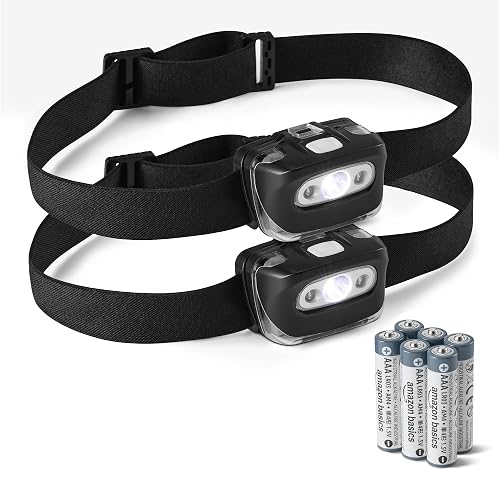
Headlamp — one per person
EssentialA headlamp beats a flashlight for one reason: it leaves both hands free to carry, to set up a shelter or to hold a child. A red mode keeps you from blinding everyone under the tent.
$19.00 View on Amazon -

A 10,000 mAh power bank
Essential2 to 3 full phone charges, for the weight of a pop can. Recharge it at the time changes, at the same time as you check the rest of the bag: a battery forgotten 3 years in a drawer doesn't give much back.
$199.99−35 %$129.99 View on Amazon -

Spare batteries, one single size
EssentialChoose your devices so they all share the same battery size — AA for preference. A full set of spares in a hard case, stored outside the devices: a battery that leaks inside a lamp destroys it.
$58.77 View on Amazon -

Folding solar panel
ComfortUseful if the evacuation stretches beyond 3 days. For a bag, stay with a light 20 to 28 W model with USB outputs: larger installations belong to self-sufficiency at home, a subject I cover on the solar page.
$124.99 View on Amazon
Communication and bearings
The cellular network is the first thing to go down and the last to come back. You need a way to receive official instructions — and a way to be found.
-

Midland ER310 — hand-crank emergency radio
EssentialIt picks up Environment Canada weather alerts and public radio, recharges by crank or by sun, and gives a phone an emergency top-up over USB. It's your source of information when nothing else works.
$140.81 View on Amazon -

Emergency whistle
EssentialA whistle carries a kilometre and doesn't wear out your voice, which gives out after a few minutes of shouting. One per person, tied to the shoulder strap — not stored at the bottom. It's the cheapest and most useful item on the whole list.
What to look for: a pealess model (the pea freezes and the whistle goes silent), plastic rather than metal — a metal whistle sticks to your lips in deep cold.$21.00 View on Amazon -

Motorola T470 — licence-free radios
Going furtherCommunication that depends on no network: when the cell towers go down, these still work. And unlike programmable radios, these require no certificate — they are Family Radio Service units, licence-exempt in Canada. Weatherproof, and they pick up weather alerts. About the advertised range: manufacturers quote kilometres measured mountaintop to mountaintop. In wooded terrain, count on one to 2 kilometres — plenty to stay in touch around a house, a property, or between 2 vehicles travelling together.
$138.91−9 %$127.00 View on Amazon -

Paper road map and contact list
Essential — nothing to buyA map of your region with the family meeting point circled, and a laminated list of the important numbers. Nobody knows a phone number by heart any more: the day the phone is dead, that sheet is worth more than everything else in the bag.
Print it, laminate it with wide packing tape, slip it into the outside pocket. Cost: zero.
-

Compact 7×25 binoculars
Going furtherSeeing at a distance saves you from going out: the level of a waterway, the state of a road, smoke on the horizon. As compact as a pair of sunglasses. At dusk, though, an objective that small darkens fast.
What to look for: a magnification of 7×, no more — beyond that the image shakes in the hand. And a size that fits a side pocket, otherwise they will stay home.$20.56 View on Amazon
First aid and medication
In an evacuation, it isn't dramatic injuries that cause the trouble, it's the small things: a blister that stops you walking, a cut that gets infected, a prescription left on the kitchen counter.
-

First aid kit
EssentialThis is the item where the price genuinely earns itself — and this one isn't an ordinary first aid kit but a trauma kit. Its difference comes down to a single object: it contains a tourniquet. That's what separates a kit that can treat a hemorrhage from a kit that can treat a scratch.
What to look for: a tourniquet from a recognized brand — the ones sold individually on marketplaces are widely counterfeited and fail under twisting, which is precisely the moment you don't want a surprise. The one proposed here is vacuum-sealed and fits in a pocket: 4 pieces only, a SWAT-T tourniquet, folded gauze, gloves and tape, where the tourniquet also serves as the pressure bandage together with the gauze. That is the format that actually leaves with you, not the big kit that stays in the basement. Bear in mind that a tourniquet is only worth having if you know how to use one: a single day of first aid training pays off more than any purchase on this page. Finally, complete it with your medication and blister dressings — on foot, the most likely injury remains the blister, not the hemorrhage.$49.41 View on Amazon -

Dräger N95 masks
Comfort2 per person. Their most likely use in Quebec isn't medical but connected to wildfire smoke, which made the air hard to breathe several summers in a row, or to dust after a collapse.
What to look for: genuine N95 certification (NIOSH) rather than a procedure mask, and straps that go behind the head rather than ear loops — that is what creates the seal. A model that folds flat stays intact at the bottom of the bag.$36.80 View on Amazon -
Your medication — 7 days ahead
Essential — nothing to buyThis is the most important point in this step, and the most often neglected. A week of each prescription medication, a copy of the prescriptions, the list of allergies, and spare glasses. Ask your pharmacist to print your medication profile: it's free and it fits on one sheet.
Note the expiry date on the calendar and rotate twice a year, at the same time as the rest of the bag.
-

Potassium iodide (KI)
Going furtherIn the event of a radioactive iodine release, it saturates the thyroid and stops it from taking up radioactive iodine. That is all it does: no protection against other forms of radiation. Only on the instruction of public health authorities — the dose depends on age. In Quebec the risk is low: Gentilly-2 has been shut down since 2012. But it keeps for years and weighs nothing.
What to look for: potassium iodide, not a plain potassium supplement — the confusion is common and the latter is useless here. 65 mg scored tablets, with a legible expiry date.$38.79 View on Amazon
Papers, cash and keys
After the emergency come the formalities: the insurance claim, temporary housing, replacing identity documents. The people who come through a disaster best are the ones who had their papers with them.
-

Waterproof document pouch
EssentialPhotocopies of identity documents, of the home insurance policy, of the mortgage contract or the lease, of vaccination records, and a recent photo of every member of the family — pets included, so they can be found. These ones are transparent: you read your papers without taking them out, so without exposing them to the rain at a shelter counter, and the touchscreen works through the plastic — enough to keep a phone dry and usable inside.
What to look for: a roll-top closure with a double zipper. Watch the size: most of these pouches take a letter-size sheet folded in half, not flat. Fold your photocopies before packing them, or choose a larger model if you want to keep them intact. Add photos of every room in the house, taken before the disaster: that's what the insurer will ask for.$15.18 View on Amazon -

Cash, in small bills
Essential — nothing to buy$200 to $300 in $5, $10 and $20 bills. Without power, payment terminals and ATMs don't work — and a merchant with no change won't give you anything back on a $100 bill. Plan for some coins as well, for a vending machine.
Hygiene and tools
The last step, and not the least useful: it's what makes 3 days bearable, and what lets you repair whatever breaks along the way.
-

Hygiene kit
EssentialA ready-made basic set — toothbrush, toothpaste, floss, soap, comb — in 6 units: one per person, or enough to last several days for 2. It's the category people cut first because it looks trivial, and it's the one that changes the mood of a third day the most.
What to look for: 4 things will still be missing, as they always are from a set like this — wet wipes (they stand in for a shower for 3 days and make an enormous difference to morale), compressed toilet paper, hand sanitizer and feminine hygiene products. Above all, add a handful of contractor-grade garbage bags: they serve as a makeshift raincoat, a rainwater collector or an insulating layer under a sleeping bag.$30.89 View on Amazon -

Compact duct tape
EssentialThe usual advice is to wind 10 metres or so of tape around a pencil rather than carry the whole roll. This format does it for you: 9 metres in a case the size of a pebble, with a water-resistant shell that keeps the tape from sticking to itself at the bottom of the bag. It repairs a torn pack, a separated sole, a tent pole — and it immobilizes an ankle in a pinch.
What to look for: tape with a reinforced backing, not packing tape. Check it once a year: the adhesive on cheap tape dries out and peels away in a sheet after 2 winters in an unheated bag.$6.99−17 %$5.77 View on Amazon -

550 paracord
Essential15 metres is enough in the bag: it rigs a shelter, replaces a bootlace, hangs food out of reach of animals, ties a bag onto a car roof. This one goes further than ordinary paracord — alongside the 7 nylon strands it carries fishing line, waxed fire-starter tinder and utility wire, braided inside. 3 more tools, without a gram more.
What to look for: genuine Type III 550 paracord — the imitations sold at the same price snap under load and are of no use. The spool runs about 30 metres: cut the length that goes in the bag and keep the rest at home or in the car. Burn the ends with a lighter so they don't fray.$71.22−11 %$63.68 View on Amazon -

Multi-tool with pliers
EssentialOne tool, but a good one. The pliers close a water or gas valve, the small serrated blade gets through a rope or a strap, and the wire cutter through a fence. It is the piece you take out once or twice a year, and that day it stands in for a toolbox.
What to look for: a locking blade, stainless steel, and a reasonable size. Buy a brand that guarantees its tool for 25 years rather than 3 successive copies — this is an object you hand down, not one you replace. A utility tool stored in a bag is carried without any problem; what isn't done is carrying it on your person as a weapon.$94.95 View on Amazon
The buying order, over 3 paycheques
Nobody buys all this at once, and there's no need to. Here's the order in which I build a bag when the budget is spread out: at every stage, the bag is already useful.
The bag stands on its own
- The backpack
- Stainless bottle and tablets
- Mylar bivies
- A headlamp per person
- Whistles
- Documents and cash
3 comfortable days
- Sawyer or LifeStraw filter
- Rations and bars
- Poncho and insulated gloves
- First aid kit
- Power bank
- Duct tape and paracord
Self-sufficiency and comfort
- Midland emergency radio
- Pocket stove
- Complete hygiene kit
- Multi-tool
- Folding solar panel
Once the bag is built, try it out: one weekend, carry it for an hour's walk and eat supper out of it. You'll take 3 useless items out and add 2 nobody had thought of. That's the exercise that turns a list into genuine preparedness.
The shopping list, at a glance
Every item on the page, grouped by step. Handy once you've read the detail and want to order without scrolling back through everything.
The cart fills in one click, and nothing is purchased: you keep control over every item. Some lines are alternatives — 2 backpacks, 2 water filters — so remove the ones you don't want. Amazon will ask you to sign in if you aren't already.
1. Water
2. Food
3. Warmth and shelter
4. Light and power
5. Communication and bearings
- Midland ER310 — hand-crank emergency radio
- Emergency whistle
- Programmable handheld radio
- Compact 7×25 binoculars
- Paper road map and contact listnothing to buy
6. First aid and medication
- First aid kit
- N95 masks
- Potassium iodide (KI)
- Your medication — 7 days aheadnothing to buy
7. Papers, cash and keys
- Waterproof document pouch
- Cash, in small billsnothing to buy
8. Hygiene and tools
The 3 items with no link aren't bought online — they're prepared. They're also, often, the most important ones.
Would you rather we built it together?
I come to your home, we empty the bag onto the kitchen table, and we look at what's actually missing — based on your area, your home and the people living under your roof. The 30-minute assessment is free, with no obligation.
Book my free assessment