As an Amazon Associate, I earn from qualifying purchases.
This commission changes nothing about the price you pay. I only list gear compatible with the setups I recommend to my clients.
Or: a portable power station, and nothing to build
Don’t want to build a solar system? You don’t have to. A portable power station gives you power without crimping a single cable: less autonomy, but nothing to understand and nothing to install — and it still recharges from solar, used panels included. They are grouped here by capacity tier, so that comparable models from one brand to the next land on the same row. But keep this in mind before you buy: it is the surge power, not the watt-hours, that decides whether your fridge starts — it is not in the table, and you will find it on each model’s Amazon page.
Compare every model31 models, 3 brands
128 to 300 Wh
Phones, radio, lamps — the small things, for days
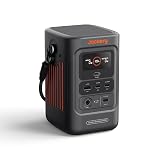 Jackery Explorer 240D256 Wh · 200 WThe lightest. Phones, lamps and radio for two or three days.
 Jackery Explorer 300293 Wh · 300 WA little more reserve in the same size. Adds a laptop to the list.
 BLUETTI Elite 10 Mini128 Wh · 200 WBackpack size, allowed in the cabin. The bare minimum, done well.
 BLUETTI AC2A204 Wh · 300 W0 to 80 % in 45 minutes: useful when the power comes back in fits.
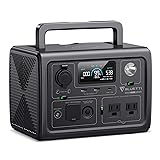 BLUETTI EB3A268 Wh · 600 WSix hundred watts from 268 Wh: it starts more than it sustains.
 BLUETTI Elite 30 V2288 Wh · 600 WPower Lifting to 1,500 W: the only one this size that wakes a small fridge.


500 to 800 Wh
Lighting, a laptop, a sump pump now and then


1,000 to 1,550 Wh
A fridge through a good part of the day
 Jackery HomePower 1000 v21,024 Wh · 1 500 W1,500 W continuous and 3,000 W surge, in a size you can still carry.
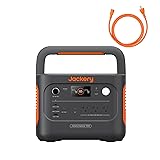 Jackery Explorer 1000 v21,070 Wh · 1 500 WThe most proven of the range: thousands of reviews behind it.


2,000 to 2,100 Wh
Fridge, freezer and furnace blower together


2,700 to 3,100 Wh
Several heavy appliances at the same time

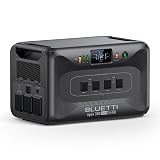
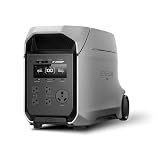
3,500 to 4,000 Wh
The long outage, not the camping weekend
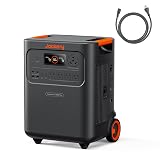


5,000 Wh and up
You are running a house, well pump included


Nothing is on sale right now.
Models are lined up by capacity tier: one row, three brands, machines that do the same job. When prices are shown, each model also carries its cost per watt-hour — the one figure that compares one brand honestly against another, and the one that tells you which discount is real. Models on sale stand out in gold. Surge power is not listed here, though it is what decides whether a fridge starts; you will find it on each model’s Amazon page.
Recharging it from solar
A station charges from the wall, but also from the sun — and a used panel in good shape works in it exactly like a new one. I sell mine in person in the Eastern Townships: 330 W used panels at $100, tested in front of you, and 500 W bifacial new panels at $200. Before plugging one in, check that its open-circuit voltage stays under your station’s input limit in deep cold: cold pushes it up. All you need then is the cable from the panel to the station: XT60 for EcoFlow and most others, DC8020 for Jackery.

Solar-to-XT60 extension — 10 AWG, 7.6 m
The extension that connects your panels to a portable power station. Standard solar connectors on one end, an XT60 plug on the other — the input found on most stations and battery packs. Gauge matters more than length: in 10 AWG these 7.6 m cost you a negligible loss, where cheap 14 AWG would cost several percent over the same distance. And the length serves a precise purpose: the panel stays in the sun while the station stays in the shade and dry. Its limitation, and it is a real one: this is a cable for a portable station, not for a series string running to a fixed MPPT controller. As soon as the open-circuit voltage climbs, or you go past one or two panels, you go back to solar connectors straight into the controller.
View on Amazon
Solar cable to Jackery (DC8020) — 12 AWG, 1.8 m
The cable that connects your panels to a Jackery station. Standard solar connectors on one end, an 8 mm plug on the other, with the DC8020 adapter included. Use the adapter: the bare plug is a DC7909, whose centre pin does not reach a Jackery's contact. That is the complaint that keeps coming up in the reviews, and that is where it comes from. In 12 AWG it easily carries the current of a 330 W panel, as well as a Jackery input, which tops out at 12 A. To go further than 1.8 m, make the run with 10 AWG solar wire and keep this cable for the last stretch, next to the station. On the largest Jackery units (3000 and up), check the adapter's fit when it arrives.
View on AmazonFrequently asked questions
What capacity of power station do I need for a power outage?
Start from your appliances, not from the station. Phones, a radio and a few lamps last several days on 300 Wh. A fridge alone needs about 1,000 Wh for a good part of the day; with a freezer and the furnace blower, aim for 2,000 Wh and up.
Why does surge power matter as much as capacity?
Capacity, in watt-hours, tells you how long the station will last. Power, in watts, tells you what it can start. A fridge draws about 150 W while running, but asks for three to six times more when the compressor starts. If the station cannot supply that surge, it shuts off, whatever its watt-hours. Output power and surge are listed on each model’s Amazon page.
Can a power station be used indoors?
Yes. Unlike a generator, a battery station burns nothing and gives off no carbon monoxide: it goes inside the house, close to the appliances. Leave space around the vents and keep it away from heat sources. A generator, on the other hand, is never used indoors or in a garage.
Does a power station recharge in extreme cold?
Most lithium iron phosphate batteries refuse any charge below 0 °C, to protect their cells. They still supply power in the cold, but no longer accept it. In winter, keep the station indoors and run the panel cable to it — or choose a self-heating model, whose spec sheet lists a charging range below zero.
Jackery, BLUETTI or EcoFlow: which one should I choose?
At equal capacity, all three do the same job — which is why the table lines them up on the same row. What sets them apart: the day’s price, the surge power, the battery chemistry (lithium iron phosphate lasts many more cycles) and whether you can add an expansion battery. Compare models within a tier rather than brands against each other.