The question is not the price, and it is not the BTUs. It is whether you can run it indoors.
3 answers exist, and the packaging does not give them away. Yes — the unit has an oxygen depletion sensor that kills the flame before the room does. Only vented outside — the combustion is sealed and the exhaust leaves through a pipe; that is the RV diesel heaters, and it is the only way to burn fuel and sleep beside it. No — an open burner with no sensor, which belongs in a garage.
2 figures to read sideways. Claimed areas assume an insulated house around −5 °C: halve them for a January here, and heat one room rather than a house. And the “8 kW” on cheap diesel heaters is a catalogue number — their own listings give 0.62 L/h, which works out to about 5 kW.
Indoors, with no power — propane and kerosene
These units carry an oxygen depletion sensor (ODS): if the room runs short of oxygen, the flame shuts itself off. That sensor, and nothing else, is what allows an open flame in a living space. A unit without one does not belong in this tier, whatever it costs.
| Model | Fuel | Output | Indoors? | Power draw | Claimed area |
|---|---|---|---|---|---|
| Mr. Heater Little Buddy | propane 1 lb | 3 800 BTU | yes | aucune | 95 pi² |
| Mr. Heater Buddy MH9BX | propane 1 ou 20 lb | 4 000 à 9 000 BTU | yes | aucune | 225 pi² |
| Mr. Heater Big Buddy | propane 1 ou 20 lb | 4 000 à 18 000 BTU | yes | 4 piles D | 450 pi² |
| Sengoku HeatMate, 23,000 BTU | kérosène | 23 000 BTU | yes | aucune | 1 000 pi² |
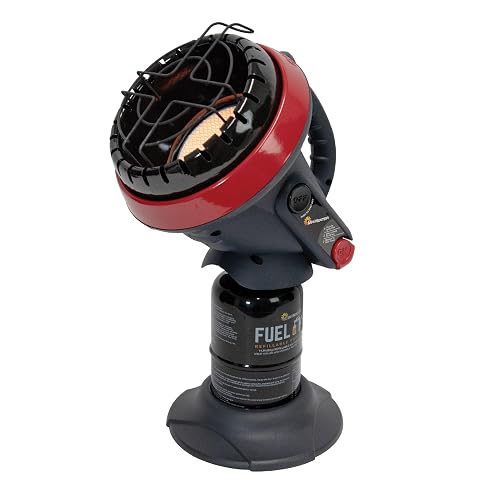
Mr. Heater Little Buddy
3 800 BTU · bouteille de 1 lb · ODS
The most important item on this page. The only model that can honestly be left running in a small closed room, and it threads straight onto a 1 lb propane cylinder — no 20 lb tank in the living room. It does not heat much: 3,800 BTU is one bedroom, not a house.

Mr. Heater Buddy MH9BX
4 000 à 9 000 BTU · 1 lb ou 20 lb · ODS
The one everybody knows, and deservedly: 2 settings, push-button ignition, tip-over switch. On a 1 lb cylinder it lasts an evening; on a 20 lb tank with the hose and filter, days. The default choice for a living room.

Mr. Heater Big Buddy
4 000 à 18 000 BTU · ventilateur à piles · ODS
Twice the Buddy, plus a fan that spreads the heat instead of leaving it in a puddle in front of the unit. The fan runs on 4 D cells, so the heat still does not depend on the grid. The model for an open room, or 2 rooms that connect.

Sengoku HeatMate, 23,000 BTU
23 000 BTU · kérosène · sans fil
Kerosene changes what the appliance is: one fill lasts the night and the next day, where a 1 lb propane cylinder lasts an evening. This one heats by convection — heat rises and fills the room instead of radiating one way. The smell shows up at lighting and at shutdown, not in between.
Sealed-combustion diesel — heating a whole night
These come from trucking and RVs, and they are the most interesting units here. The combustion chamber is sealed: burner air is drawn from outside and the gases leave outside through an exhaust pipe. Nothing from the combustion touches the air you breathe — only a heat exchanger crosses the wall. It is the only principle on this page that lets you burn a fuel and sleep beside it. The trade-off: you must cut through a wall, and they are not certified for residential installation. This is vehicle, trailer, cabin and workshop equipment.
| Model | Fuel | Output | Indoors? | Power draw | Claimed area |
|---|---|---|---|---|---|
| VEVOR 2 kW, Bluetooth | diesel | 2 kW réels | vent outside | 12 V | 108 à 161 pi² |
| VEVOR “8 kW”, 10 L tank | diesel | ≈ 5 kW calculés | vent outside | 12 V, 36 W | 215 à 269 pi² |
| VEVOR 12 V / 24 V with CO alarm | diesel | ≈ 5 kW calculés | vent outside | 12 ou 24 V | 215 à 269 pi² |
| Hcalory, 10-litre tank | diesel | ≈ 5 kW calculés | vent outside | 12 ou 24 V | 215 à 269 pi² |
| Hcalory 12 V / 24 V / 110 V | diesel | ≈ 5 kW calculés | vent outside | 12, 24 ou 110 V | 215 à 269 pi² |

VEVOR 2 kW, Bluetooth
2 kW réels · 12 V · 10 à 15 m²
The only unit in this tier whose box figure is the real one. VEVOR claims 2 kW and 10–15 m², and both hold up. The one to take for a trailer, a van or a small cabin: less fuel, less noise, and it will not cook a 150 sq ft space the way a bigger one would.

VEVOR “8 kW”, 10 L tank
≈ 5 kW réels · 12 V / 3 A · 0,16 à 0,62 L/h
Advertised at 8 kW, and the listing contradicts itself: 0.62 L/h at most is 6.1 kW in and about 5 kW out. Not a bad unit — 5 kW is a lot — but the figure that matters is elsewhere: 3 amps running. 36 watts to heat a trailer all night.

VEVOR 12 V / 24 V with CO alarm
12 V ou 24 V · alarme CO intégrée · application
The same unit with a carbon monoxide detector built into the case. On a sealed-combustion heater that detector has nothing to find when all is well — which is exactly why it earns its place: it speaks up the day an exhaust joint fails. The 24-volt option suits anyone already running a bank at that voltage.

Hcalory, 10-litre tank
12 V / 24 V · réservoir 10 L · tout-en-un
Tank, pump, burner and controls in one case you set down and plug in. 10 litres at a middling 0.25 L/h is about 40 hours untouched. The format to prefer when you do not want to install anything permanently.

Hcalory 12 V / 24 V / 110 V
accepte le 110 V · réservoir 5 L · 10 réglages
This one takes a 110-volt supply alongside 12 and 24. The point is not plugging it into the wall — it is being able to, while there is power, and switching to the battery when there is not, with no rewiring. Its vent-outside warning is printed on its own listing, and it is not decorative.
Indoors, with power
No combustion, no carbon monoxide, no smell: from the room's point of view, nothing is safer. But 1,500 watts is still 1,500 watts. On a 1 kWh battery generator that is 40 minutes. These belong in a short outage, or behind a gas generator — not for 3 days.
| Model | Fuel | Output | Indoors? | Power draw | Claimed area |
|---|---|---|---|---|---|
| De'Longhi Radia S, oil-filled | électricité | 1 500 W | yes | 1 500 W | une pièce |
| De'Longhi Dragon TRD40615ECA | électricité | 1 500 W | yes | 1 500 W | une pièce |
| DREO oil-filled radiator | électricité | 1 500 W | yes | 1 500 W | une pièce |
| PTC ceramic 1,500 W | électricité | 1 500 W | yes | 1 500 W | petite pièce |

De'Longhi Radia S, oil-filled
1 500 W · bain d'huile · silencieux
Oil-filled means no fan: no noise, no dust blown around. It takes 20 minutes to come up, then keeps giving heat after it shuts off because the oil holds it. The best match for a thermostat and a bedroom.

De'Longhi Dragon TRD40615ECA
1 500 W · ailettes profilées · thermostat
Same wattage as the Radia S, but the fins are shaped to pull more air along the metal. Equal watts create no extra heat — they just leave the unit faster. You feel the difference in a large room, not a bedroom.

DREO oil-filled radiator
1 500 W · télécommande · verrou enfant
The modern take on oil-filled: remote, 4 modes, tip-over protection and child lock. Thermally identical to the 2 above — what you buy here is the control.

PTC ceramic 1,500 W
1 500 W · céramique PTC · prise ALCI
The opposite of oil-filled: hot in 10 seconds, cold 10 seconds after it stops. Small, light, and the cheapest here. The ALCI plug is a ground-fault breaker built into the cord, which is why it is sold as a bathroom heater. Keep it as a stopgap, not as your baseline heat.
Garage and workshop only
These are open high-output burners with no oxygen sensor, and they consume the room's air. They will warm a 2-car garage in 20 minutes, and they have no business in a living space or behind closed doors. Put plainly: jobsite equipment.
| Model | Fuel | Output | Indoors? | Power draw | Claimed area |
|---|---|---|---|---|---|
| VEVOR forced air, 60,000 BTU | propane 20 lb | 60 000 BTU | no | 120 V requis | 1 500 pi² |
| King Industrial, 60,000 BTU | propane 20 lb | 60 000 BTU | no | 120 V requis | 1 500 pi² |
| Dyna-Glo Workhorse KFA80WH | kérosène ou diesel | 80 000 BTU | no | 120 V requis | 1 900 pi² |

VEVOR forced air, 60,000 BTU
60 000 BTU · propane · 120 V requis
The cheapest route to the biggest output on this page, and that follows: there is almost nothing inside. A burner, a fan, a thermostat. It needs an outlet for the fan — so a generator, which rules it out in a full outage.

King Industrial, 60,000 BTU
60 000 BTU · propane · acier
Same output, tool-grade build: thicker shell, replaceable parts. For anyone using it every winter day rather than twice a season, the price difference pays for itself the first winter.

Dyna-Glo Workhorse KFA80WH
80 000 BTU · kérosène ou diesel · 120 V requis
80 000 BTU, and it takes kerosene, diesel or heating oil — the same jug as the trailer heater and the tractor. The machine for big uninsulated buildings. Loud, smelly, and formidably effective.
What goes with it
4 parts that heat nothing and settle everything else: the one that warns you, the one that vents, the one that keeps propane from clogging a regulator, and the one that runs a 12-volt heater off a wall outlet.

First Alert CO400, battery CO alarm
à piles · indépendant du réseau
It is not the part you buy “if there's budget”. A plug-in detector does nothing on the evening the power is out and you light a burner. This one runs on its batteries, which is to say precisely when it is needed.

Stainless exhaust pipe, 1 in
acier inoxydable · Ø intérieur 25 mm
The pipe supplied with diesel heaters is usually short and thin. This one lets the exhaust exit farther from the air intake and from any opening. On a sealed-combustion unit this pipe is the safety part, not an accessory.

Propane hose and filter for Buddy
1,8 m · filtre F273699 · tresse inox
What turns a Buddy from “one evening” into “one week”: it connects to a 20 lb tank. The filter is not optional — propane hoses shed a plasticizer that clogs the heater's small orifice, and that is the number-one failure of these units.

110 V to 12 V supply for diesel heaters
110 V → 12 V · 180 W · 15 A · prise 12 V
To run a 12-volt diesel heater from a wall outlet while there is power, and fall back to the battery when there is not. 36 watts while running: any battery generator will carry it for days. The unit delivers 180 W, or 15 amps — headroom for the glow plug, which draws far more than the running load. The 12 volts comes out of a cigarette-lighter socket: plan for the matching plug if your heater connects by bare wires.
The number that settles it
An electric heater draws 1,500 W. A sealed diesel heater draws 36 W and makes 3 times the heat. On a 1 kWh battery generator that is 40 minutes against about a day.
That gap is the whole argument. Electricity is the cleanest heat and the worst one to store; a fuel is the opposite. Which is why the sensible answer is usually both: electric while the grid holds, a burner when it does not.
And no heater on this page is safe without the battery carbon monoxide alarm above. Not because these products are bad, but because CO has no smell and no colour, and a plug-in detector is dead on exactly the evening you light a burner.